Cao Cao Mobility opens combined robotaxi and robovan pilot in Suzhou
The Xiangcheng project pairs autonomous passenger and delivery vehicles with an automated battery-swapping and fleet-service hub
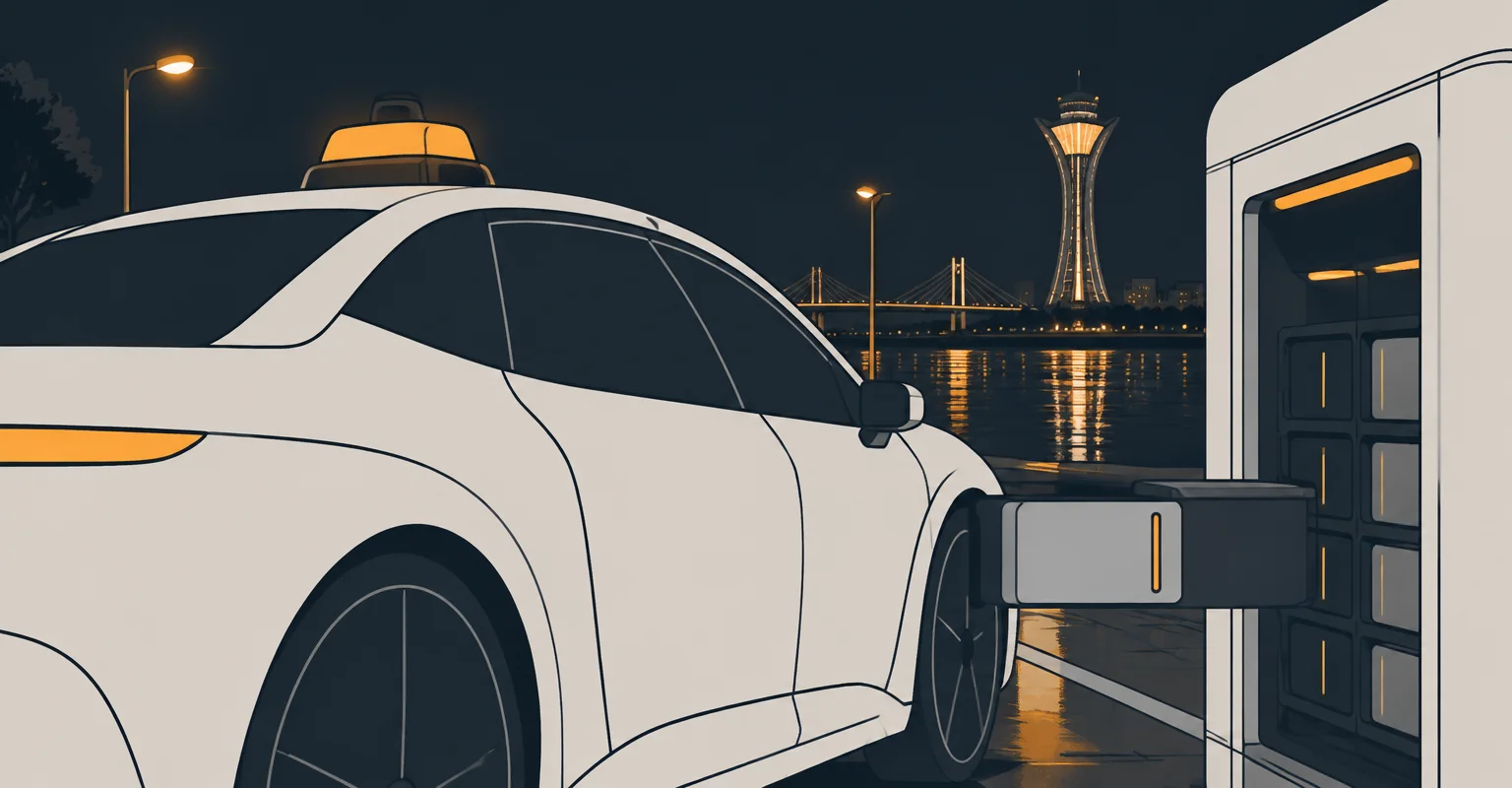
Cao Cao Mobility has begun a physical-AI mobility pilot in Xiangcheng District, Suzhou, combining robotaxi and robovan operations with an automated service hub. Announced Oct. 27 at the 8th Intelligent Driving Conference and the 2026 Huanxiu Lake Physical AI Industry Development Promotion Conference, the project makes Suzhou the company’s first city to deploy all three elements together.
The announcement, reported by BigGo Finance, positions the scheme as a real-world test of whether autonomous transport can move beyond technical validation into scaled commercial operations. Cao Cao plans to coordinate passenger robotaxis, autonomous delivery vehicles and the Green Intelligent Mobility Island under its RoboX strategy, rather than test a single vehicle type in a restricted area.
Suzhou’s first Green Intelligent Mobility Island has been completed and put into operation. It combines automated battery swapping, cleaning, vehicle preparation, dispatching and settlement, with the aim of allowing autonomous vehicles to enter stations and undergo operations and maintenance without manual handling.
The pilot is intended to test a harder commercial question: whether a driverless fleet can take orders continuously, recharge, manage anomalies and generate profitable operating data in an urban setting. The company also plans a Suzhou AI Center, an RAS Vehicle-Road-Cloud Integration Center and an intelligent-cockpit center, intended to support an ecosystem spanning AI large models, vehicle-road collaboration and vehicle interfaces.
The RAS center’s safety system integrates vehicles, cloud systems, roads and people, and provides round-the-clock cloud monitoring and remote-intervention support for the autonomous fleet. Cao Cao says its wider operating systems, covering dispatch, vehicle assets, user service and compliance, already operate across 215 Chinese cities.
Cao Cao’s robotaxi business now spans six cities, including Suzhou, Hangzhou, Shanghai and Zhuhai, with a fleet of more than 200 vehicles. It has also started testing robotaxis in Hangzhou without a safety officer in the driver’s seat. Its robovan operations have entered commercial service, serving uses including express delivery, supermarkets and food and fresh-produce distribution.
The company is developing a third-generation purpose-built robotaxi with Geely Auto. The vehicle is designed for the operating needs of autonomous services, with its hardware architecture, interior space and maintenance arrangements tailored to high-frequency use rather than private passenger-car ownership. Gasgoo separately reported that the Geely-Cao Cao version is scheduled for production in 2027.
Cao Cao uses its CurbX curb-management engine, informed by its manned ride-hailing operations, to identify pickup and drop-off locations suited to robotaxi use. The company says the system should improve the speed of entering new cities and the design of station networks.
The Suzhou project is due to complete demonstration validation this year through a smoothly operating robotaxi-robovan business loop. Cao Cao plans scaled replication in 2027, through higher vehicle density, a broader service area and standardized products and operations, before pursuing an open service platform and industry-standard work by 2030.
- City: Suzhou
- Operator: Cao Cao Mobility