NHTSA reviews Tesla robotaxi school-zone speeding allegations
The preliminary defect-petition review covers Model Y robotaxis and Cybercabs, with no crashes or injuries listed in the filing
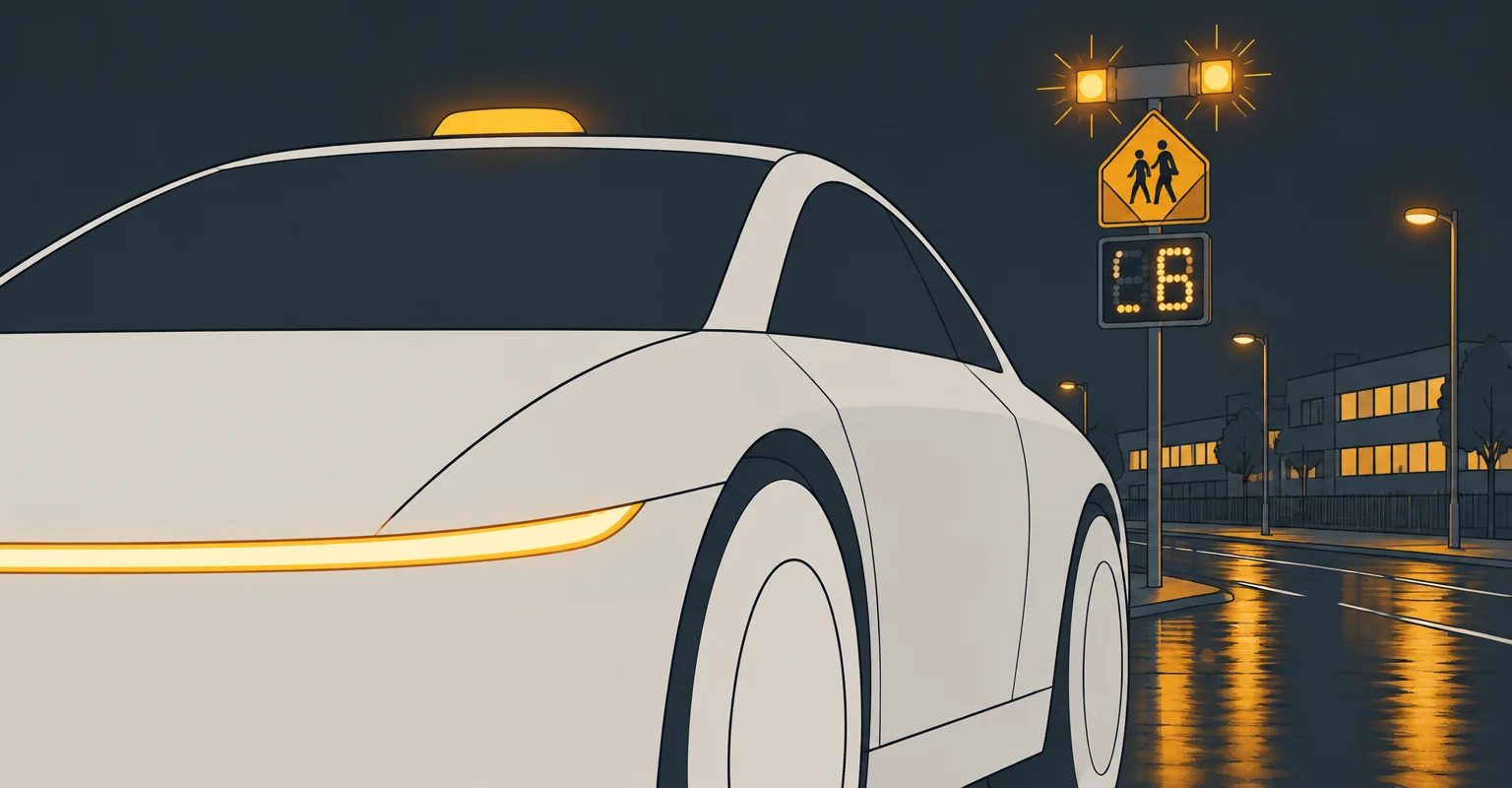
The National Highway Traffic Safety Administration has opened a defect-petition review into allegations that Tesla robotaxis exceeded posted limits in active school zones while their automated driving systems were engaged. The review, DP26010, covers 2026-model-year Tesla Model Y robotaxis and Cybercabs, with the agency estimating a potentially affected population of about 1,000 vehicles.
The petition, received Sept. 23 and opened Oct. 9, alleges that the vehicles’ automated driving systems “exceed posted speed limits in active school zones.” It included links to three videos. NHTSA’s failure-report summary records four incidents: one complaint filed directly with its Office of Defects Investigation and three social-media reports submitted with the petition.
The filing lists no crashes, fires, injuries or fatalities. The review is an initial decision on the petition, rather than a formal defect investigation. NHTSA will determine whether to grant or deny it; a grant would open a formal investigation that could ultimately lead to a recall.
Federal rules give the agency 120 days from receipt of a defect petition to decide. That places the deadline around Jan. 21, according to Electrek’s calculation. Tesla does not disclose the size of its robotaxi fleet, although NHTSA’s estimate is substantially higher than the few dozen active cars community trackers counted across Austin, Dallas and Houston in June.
Tesla’s service has expanded beyond Austin to Dallas and Houston in Texas, and to Tampa, Orlando and Miami in Florida. The school-zone petition itself concerns Model Y robotaxis as well as the steering-wheel-free, pedal-free Cybercab.
State rules establish who is legally responsible when an automated driving system is operating. Texas law treats the engaged system as the operator for traffic-law compliance, while directing citations to the vehicle owner or holder of the driverless operating authorization. Florida law also deems an engaged automated driving system to be the operator; its school-zone camera regime sends notices to the registered owner when a vehicle is recorded travelling more than 10 mph above the limit during the specified school-period window.
The new review is separate from NHTSA’s examination of Tesla’s Cybercab self-certification, as we reported in September. That audit, AQ26002, is examining the methodology and technical information behind Tesla’s assertion that the driverless vehicle meets federal motor-vehicle safety standards.
It also follows NHTSA’s October 2025 preliminary evaluation of Tesla’s consumer Full Self-Driving systems, which is distinct from this robotaxi petition. That inquiry covers about 2.9 million vehicles equipped with FSD (Supervised) or FSD (Beta), after reports including vehicles proceeding through red signals and travelling against the proper direction of traffic. NHTSA describes FSD as Level 2 partial automation, requiring an attentive human driver responsible for driving and obeying traffic laws.