Tesla begins supervised Cybercab testing on Detroit roads
About two dozen vehicles have been seen around Metro Detroit with temporary steering wheels, while Waymo continues driverless tests in the region.
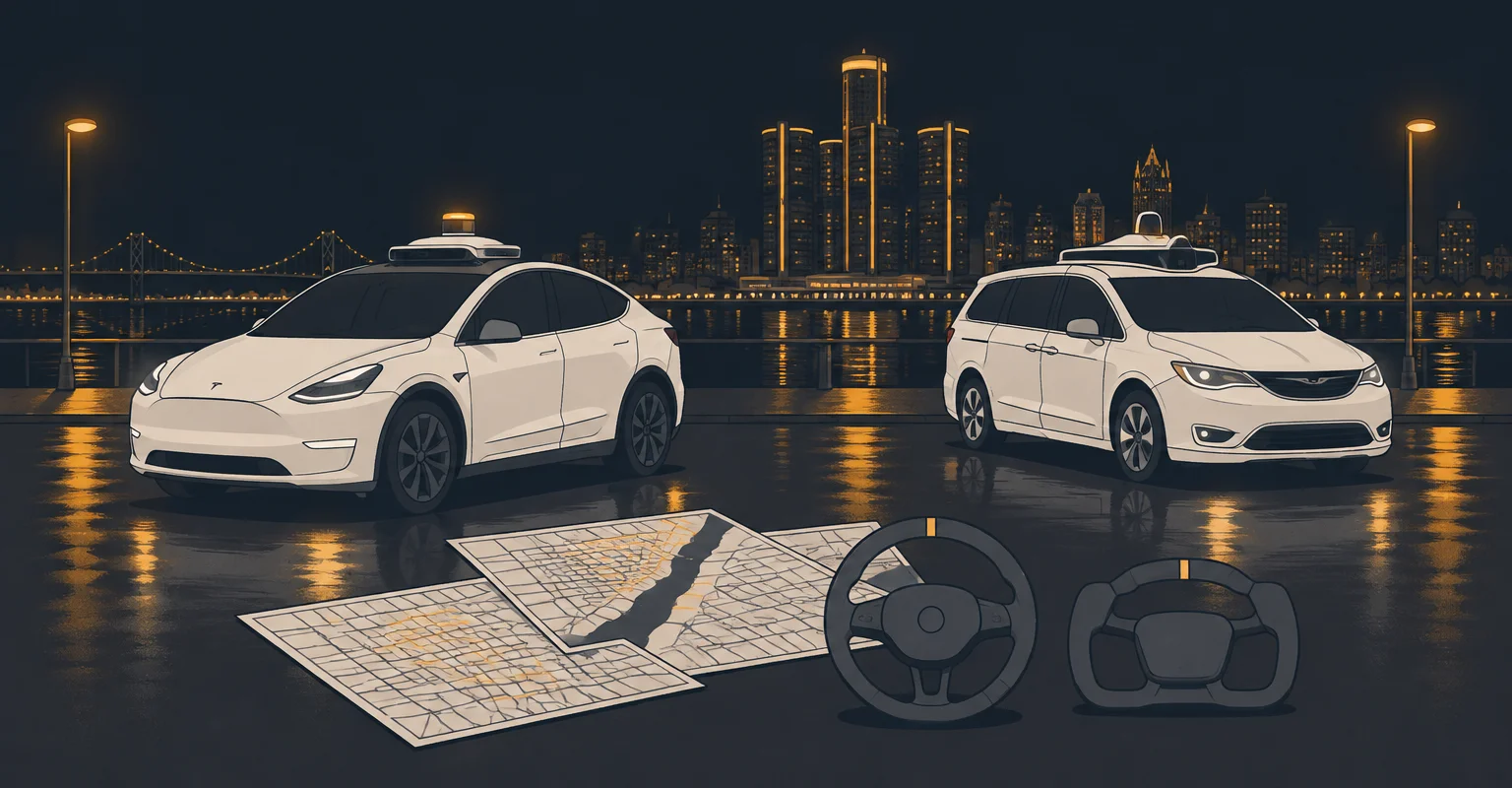
Tesla has begun testing about two dozen Cybercabs on roads around Detroit, running the vehicles from its collision-repair facility on 12 Mile Road in Southfield. The two-seat cars have been seen on I-696, M-10, Telegraph Road and Eight Mile Road, with test drivers using temporary steering wheels.
Tesla has not publicly confirmed the Michigan programme or specified its purpose, according to the Detroit News. The Cybercab is intended to operate without a steering wheel when fully deployed, making the supervised road tests distinct from its planned driverless use.
The Detroit operation is Tesla’s latest known testing location rather than a public Cybercab launch. Austin remains the only city where the Cybercab is publicly accessible. Tesla’s broader Robotaxi service also uses Model Y vehicles in Austin, Dallas and Houston, Texas, and in Tampa and Miami, Florida.
The move follows Tesla’s supervised Cybercab road testing in New York, as covered in September. Cybercabs have also been spotted at Miami International Airport and near Philadelphia, although those sightings did not establish public Cybercab operations in either market.
Detroit puts Tesla alongside Waymo in a region where different weather conditions may be valuable for autonomous-vehicle development. Stephanie Brinley of Mobility Global said testing in different cities and weather situations was important, while describing Detroit as symbolically significant but offering less potential use than New York or Chicago. Tesla test drivers are subject to nondisclosure agreements.
Waymo began testing in the Detroit region roughly a year before Tesla’s Cybercab appearance and started fully autonomous tests there in October using Zeekr Ojai vehicles without human specialists at the wheel. Chris Bonelli, a Waymo product communications manager, said there was no timeline for a public Detroit deployment.
The companies are pursuing different sensor approaches. Cybercabs use cameras only, while Waymo combines lidar, radar and cameras. The Detroit News reported that Tesla’s camera-only approach is expected to cost less to operate at scale. Waymo has logged 270 million miles in cities including San Francisco, Phoenix and Atlanta, compared with more than 4 million miles logged by Tesla’s Robotaxi service, according to Tesla’s website.
The Michigan tests also come while the National Highway Traffic Safety Administration examines Tesla’s self-certification that the Cybercab complies with applicable federal safety standards. The agency said its Audit Query, opened after the Austin deployment, will review Tesla’s technical data and certification process, including whether some requirements were considered inapplicable to automated vehicles. Existing federal safety standards remain in force, NHTSA said.
Tesla had said Cybercab expansion would begin in Dallas in November and extend to other cities by the end of the year, although regulatory approvals were needed before vehicles could be deployed as quickly as they were produced.
See also
- Tesla Cybercabs test New York streets with human drivers at the wheel
- Tesla plans unsupervised Cybercab rides in Dallas in November
- Tesla points to Dallas after Austin Cybercab fleet passes 300
- Tesla’s Texas robotaxi registrations pass 500 as Cybercab count surges
- NHTSA audits Tesla’s Cybercab safety self-certification after Austin launch